
- -5%
- New
 AROMATHERAPY
 INCENSES
 CANDLES
 JEWELRY AND ORGONITE
 DECORATION
 ESOTERICISM
 MINERALS AND CRYSTALS











































 NEWS New
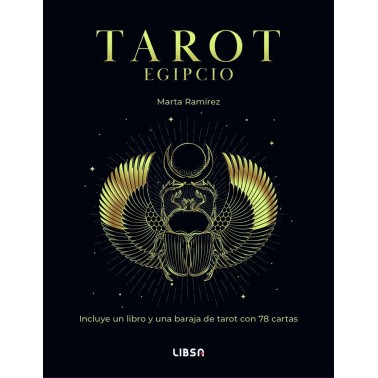
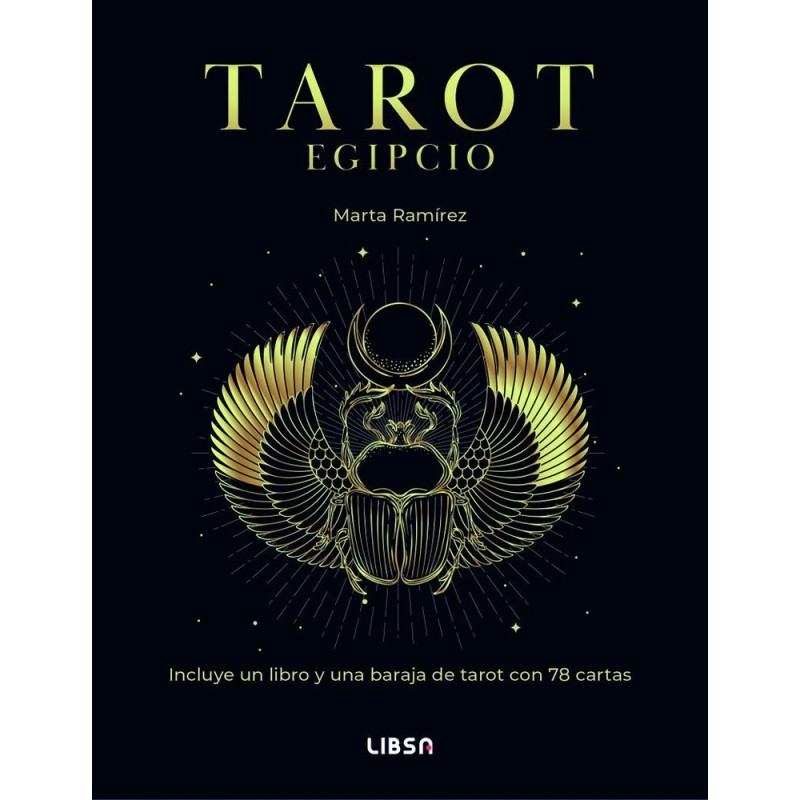
Discover the Egyptian Tarot by Marta Ramírez, a complete divination pack that includes a deck of 78 cards and an explanatory book of 192 pages in Spanish , published by LIBSA within its Magic Boxes collection.
This set invites you to explore the symbolic universe of the Egyptian-inspired tarot through the study of the Major and Minor Arcana, their interpretations, and their relationships with esoteric disciplines such as numerology, astrology, and Kabbalah.
Through its explanations, the book allows you to understand the individual meaning of the cards and learn how to relate them to each other to develop more elaborate readings.
The included deck offers the possibility of putting the knowledge from the manual into practice, from simple queries to combinations of several cards.
✨ An ideal pack for those who want to learn Egyptian Tarot, delve deeper into cartomancy, or discover the symbolic connections between tarot, astrology, numerology, and esoteric traditions.
This set brings together the necessary materials to begin exploring the reading system proposed by the author.
🃏 78 Egyptian Tarot cards: a complete deck for practicing different readings.
📖 192-page book: explanations of the meanings of the Major and Minor Arcana.
🔢 Numerology: references to the symbolic associations between numbers and cards.
🌌 Astrology: interpretive connections with astrological language.
✡️ Kabbalah: an approach to the esoteric correspondences present in the system.
🔮 Spreads and combinations: guidelines for interpreting individual cards and sets.
🐍 Egyptian symbolism: an aesthetic and approach inspired by the imagery of ancient Egypt.
🎁 Boxed presentation: book and deck together in the same case.
🇪🇸 Spanish edition: explanatory content accessible to Spanish-speaking readers.
Its main advantage is that it combines theory and practice in a single product.
The Egyptian Tarot is a form of cartomancy that uses images, names, and associations inspired by the culture and mythology of ancient Egypt.
His visual language often incorporates references to temples, deities, hieroglyphs, human figures, and symbols related to the Egyptian religious universe.
These representations are combined with interpretations developed within different modern esoteric traditions.
Although some occult systems have linked the tarot to ancient Egypt, there is no solid historical evidence that the 78-card tarot originated in the Pharaonic civilization .
Documented tarot decks appeared in Europe during the 15th century, while Egyptian associations spread especially through later occult movements.
Marta Ramírez's Egyptian Tarot belongs to this symbolic tradition and allows you to explore it through a deck and an interpretation manual.
The pack contains a deck of 78 cards, accompanied by a book that explains their meanings.
The manual addresses the Major and Minor Arcana and offers guidelines for interpreting their relationships.
In 78-card tarot systems, the Major Arcana often represent major symbolic themes such as knowledge, decisions, transformation, cycles, and personal evolution.
Egyptian-inspired playing cards can reinterpret these concepts through figures and references from their iconography.
The Minor Arcana allow for the development of interpretations related to more concrete situations, everyday experiences, and relationships between different elements of a reading.
Its structure and names may vary depending on the Egyptian Tarot system used.
Therefore, to understand the exact organization and specific meanings of this edition, it is recommended to follow Marta Ramírez's manual.
One of the great attractions of the pack is its explanatory manual.
The book does not simply present an isolated description of each letter.
It also addresses the relationship between the different arcana and how their meanings can be combined within a spread.
This structure allows for a gradual progression from simple interpretations to more complex readings.
The publisher announced the following contents:
Meaning of the Major Arcana.
Meaning of the Minor Arcana.
Individual interpretation of the cards.
Relationships between letters.
Easy readings.
Combinations for complex readings.
Correspondences with numerology.
Astrological references.
Associations with Kabbalah.
Practical examples of print runs.
The book thus offers a reference base for those who wish to study the symbolism of the deck.
Numerology is an esoteric practice that attributes symbolic meanings to numbers.
Within some tarot systems, the numerical values of the cards are related to ideas such as beginnings, balance, development, transformation, and the culmination of cycles.
These associations can be used as additional resources for interpreting a reading.
Marta Ramírez's Egyptian Tarot manual incorporates numerology guidelines that expand the study of the cards.
In this way, the reader can explore how numbers intervene in the symbolic language of cartomancy.
Astrology has maintained an important relationship with different modern esoteric currents.
Some tarot systems establish correspondences between cards, planets, zodiac signs, and other astrological elements.
These associations allow for the development of complementary symbolic interpretations.
The LIBSA Egyptian Tarot includes references to astrology within its manual, offering another perspective for studying the cards.
Specific correspondences should be consulted in the book, as they may vary between different traditions and authors.
Kabbalah is a Jewish mystical tradition that has also influenced various currents of Western esotericism.
In modern occultism, systems of correspondences have been developed between tarot, Hebrew letters, and concepts associated with the Tree of Life.
These later esoteric associations should be distinguished from the historical study of Kabbalah within Judaism.
Marta Ramírez's manual incorporates guidelines related to Kabbalah as part of her proposed interpretation of the Egyptian Tarot.
This dimension may be of interest to readers who wish to explore different symbolic languages within cartomancy.
The civilization of ancient Egypt has sparked great interest due to its architecture, religious practices, writing, and artistic representations.
Temples, pyramids, amulets, hieroglyphs, and divine figures are part of a cultural heritage that has influenced numerous artistic and esoteric movements.
In the imagery of the Egyptian Tarot, these elements can serve as visual references to represent concepts related to knowledge, transformation, and spirituality.
The appeal of this theme lies in the combination of history, mythology, and subsequent symbolic reinterpretations.
It is important to distinguish the historical beliefs of the ancient Egyptians from the interpretations created by modern schools of tarot.
Among the most well-known figures in the religion of ancient Egypt we find:
Isis: a deity associated with motherhood, protection, and magic in various Egyptian traditions.
Osiris: a figure linked to death, regeneration, and life after death.
Horus: deity associated with royalty, the sky and protection.
Anubis: deity related to funeral rites and the protection of the deceased.
Thoth: a deity associated with writing, knowledge, and wisdom.
Bastet: goddess associated with protection and frequently represented with feline attributes.
These figures allow us to understand part of the mythological context that inspires numerous esoteric products with Egyptian themes.
Their mention here is contextual and does not imply that they all necessarily appear in the 78 cards of this edition.
A simple way to begin is to practice reading a single card.
Daily reading of a letter:
Find a quiet space.
Shuffle the 78 cards.
Reflect on a question or situation.
Draw a card.
Observe its symbols and details.
Look up its meaning in the book.
Write down the ideas that you find relevant.
Repeat the exercise to familiarize yourself with the deck.
Once you are more familiar with the cards, you can start using multi-position spreads.
A simple reading suggestion involves using three cards.
First letter – Situation
It symbolically represents the context of the consultation.
Second letter – Influences
It invites you to consider factors or circumstances that may be involved.
Third letter – Orientation
It offers a starting point for reflecting on decisions and possibilities.
This spread is a general practice suggestion and not a literal reproduction of the instructions in the book.
One of the features highlighted by the publisher is the study of the relationships between letters.
In a multi-position reading, each card can be interpreted individually, but it can also acquire new nuances when related to the others.
For example, a card symbolically associated with change may be interpreted differently when it appears next to another card related to stability or reflection.
The manual allows you to explore these relationships through explanations and practical examples.
This is especially interesting for those who wish to go beyond reading a single card and develop more elaborate interpretations.
Marta Ramirez's Egyptian Tarot can be an interesting option for people who want to start studying this cartomancy system.
It includes a complete deck of cards and an instruction book, so there's no need to purchase both items separately.
His approach combines the individual study of the arcana with the practice of spreads and combinations.
It may also be useful for readers who are already familiar with other tarot systems and wish to explore an Egyptian-inspired deck.
Although both belong to the universe of cartomancy, they present visual and interpretative differences.
Egyptian Tarot:
It uses iconography inspired by ancient Egypt.
It can incorporate astrological and numerological correspondences.
There are different systems of interpretation.
Specific names and structures may vary depending on the edition.
Tarot of Marseille:
It is related to a European historical tradition.
It features characteristic figures and symbols.
It uses a classic structure of Major and Minor Arcana.
Their numbered Minor Arcana usually feature compositions based on suits.
The Egyptian Tarot from LIBSA offers an alternative for those who wish to explore another visual language within cartomancy.
This pack may be of particular interest to:
People who want to learn Egyptian Tarot.
Beginners in cartomancy.
Collectors of tarot decks.
Fans of Egyptian mythology.
People interested in numerology.
Students of esoteric astrology.
Readers interested in Kabbalistic correspondences.
Tarot readers looking for new decks.
People who want to practice complex spreads.
Those looking for an esoteric gift with a book and cards.
Its boxed presentation and complete contents make it a practical option for both personal use and as a gift.
Title: Egyptian Tarot.
Subtitle: Includes a book and a tarot deck with 78 cards.
Author: Marta Ramírez.
Publisher: LIBSA.
Collection: Magic Boxes.
Collection number: 2.
Language: Spanish.
Year of publication: 2025.
Number of cards: 78.
Book: 192 pages.
Format: Box with book and deck of cards.
Card dimensions: 7 × 12.5 cm.
Book dimensions: 12 × 16 cm.
ISBN / EAN: 9788466245104.
It includes a deck of 78 cards and a 192-page instruction booklet in Spanish.
Marta Ramírez.
LIBSA Publishing House, within its Magic Boxes collection.
Contains 78 Egyptian Tarot cards.
Yes. The book addresses the meanings of both groups of arcana.
Yes. This edition is published in Spanish.
Yes. It includes explanations about spreads, combinations, and card interpretation.
Yes. The manual incorporates numerology guidelines.
Yes. Astrology is part of the esoteric correspondences discussed in the book.
Yes. The publisher confirms references to Kabbalah within the content.
It can be, since it brings together the cards and a reference manual in the same set.
It's a modern deck inspired by Egyptian symbolism. The tarot as a card system has its documented origins in Europe, not in Pharaonic Egypt.
You can find the Egyptian Tarot by Marta Ramírez, ISBN 9788466245104 , at Hostenatura , an online store specializing in tarot, oracles, cartomancy and esoteric products.
If you're looking for an Egyptian-inspired tarot deck with a complete manual to learn how to interpret the cards, this pack from Marta Ramírez is a particularly interesting option.
Its 78 cards and 192-page book allow you to study the arcana, learn about esoteric correspondences, and practice readings of varying complexity.
At Hostenatura you will also find other Egyptian tarot decks, classic decks, cartomancy books, pendulums and divination accessories.
🐍🔮 Discover the Egyptian Tarot by Marta Ramírez and explore the symbolism of its 78 cards with a complete interpretation manual.
Discover the Egyptian Tarot by Marta Ramírez, a complete divination pack that includes a deck of 78 cards and an explanatory book of 192 pages in Spanish , published by LIBSA within its Magic Boxes collection.
This set invites you to explore the symbolic universe of the Egyptian-inspired tarot through the study of the Major and Minor Arcana, their interpretations, and their relationships with esoteric disciplines such as numerology, astrology, and Kabbalah.
Through its explanations, the book allows you to understand the individual meaning of the cards and learn how to relate them to each other to develop more elaborate readings.
Contact us!
Contact us on WhatsApp!