
- -15%
- New
 AROMATHERAPY
  INCENSES
  CANDLES
  JEWELRY AND ORGONITE
  DECORATION
  ESOTERICISM
  MINERALS AND CRYSTALS



















































 NEWS New
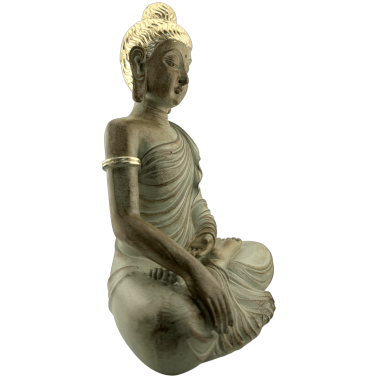
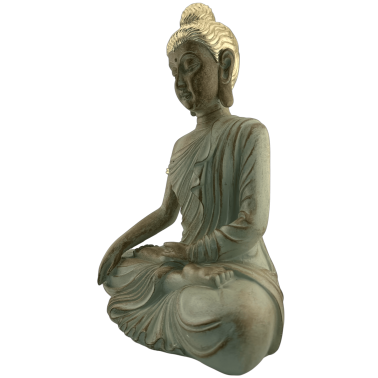
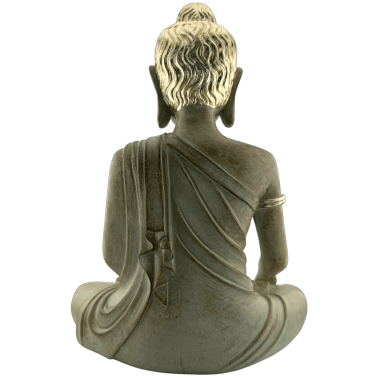
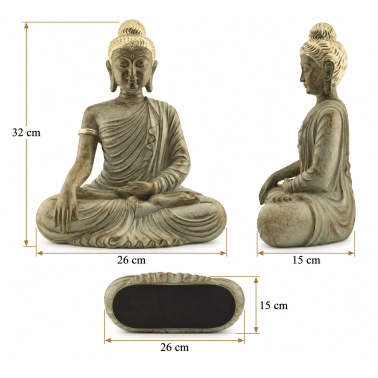
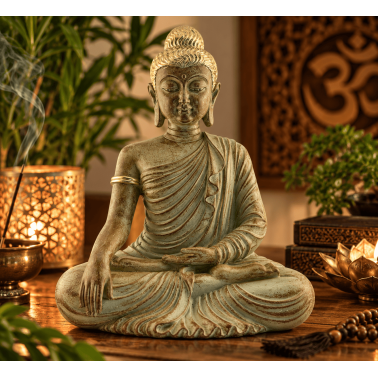
The 26 × 15 × 32 cm Seated Buddha of Enlightenment Figure with Bhumisparsha Mudra represents one of the most important and recognizable scenes of the Buddhist tradition: Buddha seated in meditation while his right hand descends to touch the Earth .
This gesture is called Bhumisparsha Mudra , a Sanskrit expression that can be translated as "gesture of touching the Earth" or "taking the Earth as a witness."
It's not simply a meditative posture.
It symbolically represents one of the culminating moments in the story of Siddhartha Gautama: his path to awakening or enlightenment .
The 26 × 15 × 32 cm Seated Buddha of Enlightenment Figure with Bhumisparsha Mudra represents one of the most important and recognizable scenes of the Buddhist tradition: Buddha seated in meditation while his right hand descends to touch the Earth .
This gesture is called Bhumisparsha Mudra , a Sanskrit expression that can be translated as "gesture of touching the Earth" or "taking the Earth as a witness."
It's not simply a meditative posture.
It symbolically represents one of the culminating moments in the story of Siddhartha Gautama: his path to awakening or enlightenment .
Therefore, this figure brings together some of the deepest concepts associated with the image of Buddha:
🪷 Lighting
🌍 The Earth as witness
🧘 Meditation
✨ Spiritual awakening
💪 Determination
🌳 The moment under the Bodhi tree
🙏 Overcoming temptations
☸️ Buddhist path
At 32 cm tall , it has a considerably greater presence than small altar figures, making it a key piece for living rooms, entrances, meditation spaces, yoga centers, consulting rooms, altars or oriental-inspired decorations.
🪷 Seated Buddha · 🌍 Bhumisparsha Mudra · ✨ Enlightenment · 🧘 Meditation · 🌳 Bodhi Tree · ☸️ Awakening
Bhumisparsha comes from Sanskrit and refers to the act of touching the Earth .
The gesture is easily recognizable.
Buddha remains seated while:
🧘 maintains a meditative posture,
🤲 One hand rests on her lap,
and
🌍 The right hand descends towards the Earth.
The fingers point downwards until they touch or approach the ground.
This position is known as:
and is traditionally interpreted as:
To truly understand this figure, we must return to one of the central episodes of the Buddhist tradition.
Siddhartha Gautama had dedicated years to searching for an answer to suffering and the nature of existence.
Finally, he sat down to meditate under the tree that would later be known as:
Determined to remain there until he achieved the understanding he sought.
According to traditional Buddhist narratives, during this process Māra appears, a figure related to obstacles, temptations, and that which tries to prevent awakening.
Faced with Māra's challenge, Siddhartha does not abandon his meditation.
This moment is what the Bhumisparsha Mudra represents.
After overcoming obstacles and continuing deeply in meditation, Siddhartha achieves awakening.
It becomes:
that is to say:
That is why we have named this representation:
It's not just an attractive brand name.
It precisely describes the episode to which the Bhumisparsha Mudra traditionally refers.
This is probably the most powerful idea behind the figure.
Buddha does not need to display physical strength.
He doesn't raise a weapon.
No combat.
He maintains his determination and touches the Earth.
The scene thus becomes a powerful symbol of:
💪 Firmness
🧘 Determination
🌍 Connection with the Earth
✨ Conviction
🙏 Spiritual perseverance
🌳 Stability
The answer to the challenge is not to abandon the path.
It is to remain.
The Buddha's posture further reinforces the meaning of the scene.
Sitting and stable, it visually conveys:
🪷 Serenity
🧘 Meditation
☯️ Balance
🌳 Stability
🙏 Concentration
✨ Presence
The lighting is not represented by movement or agitation.
Quite the opposite.
The Bodhi tree is closely linked to the story of Siddhartha Gautama's enlightenment.
“Bodhi” can be roughly translated as:
either
Therefore, both the Bodhi tree and the Bhumisparsha Mudra have become two particularly recognizable symbols of Buddha's awakening.
Even if a figure does not physically include the tree, the gesture of touching the Earth can immediately bring to mind this episode.
Within Buddhist narratives, Māra plays a fundamental role at this time.
It can be understood within different interpretations as a representation of obstacles, temptations and forces that make it difficult to achieve awakening.
This scene also allows for a contemporary symbolic reading.
We can all find:
🌑 Distractions
😨 Fears
💭 Questions
🚧 Obstacles
🌀 Confusion
⚠️ Temptations to quit
The Bhumisparsha Mudra can symbolically remind us of the importance of standing firm when what we seek has true meaning for us.
In contemporary spiritual interpretations, the gesture of touching the Earth is also often used as a symbol of:
🌍 Rooting
🌿 Stability
🧘 Presence
🌳 Connecting with the present moment
☯️ Balance
These readings may be useful as personal symbolism, although they should not necessarily be confused with a single or complete definition of the historical meaning of the mudra.
His fundamental Buddhist reference continues to be:
Although both figures represent Buddha seated, the meaning changes significantly depending on the position of the hands.
Buddha of Wisdom
📖 Teaching
🧠 Wisdom
💬 Knowledge transfer
🙏 Understanding
The thumb and index finger form the characteristic circle.
Buddha of Enlightenment
✨ Awakening
🌍 Earth as witness
🧘 Meditation
💪 Determination
🌳 Lighting under the Bodhi tree
The right hand descends towards the Earth.
Therefore, they are not simply two different designs of Buddha:
With dimensions of:
This figure has a significant decorative presence.
Its 32 cm height allows it to be used as a main piece instead of limiting it to small corners.
It may be especially appealing in:
🏡 Halls
🚪 Tickets
🧘 Meditation spaces
🪷 Altars
🌿 Zen corners
🧘♀️ Yoga centers
💆 Wellness centers
📚 Offices
🏨 Receptions
✨ Spaces inspired by the Orient
The Buddha Bhumisparsha is especially appropriate for a space dedicated to meditation.
His image is reminiscent of:
It can be used as a focal point within a corner, accompanied by:
🕯️ Candles
🔥 Incense
🌿 Plants
🥣 Bowls
📿 Bad
💎 Decorative elements
🪷 Flowers
You don't need to add many objects.
The figure itself, with its size of 32 cm , can easily become the visual center of the space.
Beyond its religious significance, this figure can be incorporated into decorative projects of inspiration:
🪷 Buddhist
🌿 Zen
🏯 Oriental
🧘 Meditative
✨ Spiritual
☯️ Minimalist
It pairs particularly well with:
🪵 Wood
🌿 Green plants
🪨 Stone
🕯️ Warm lighting
🎍 Decorative Bamboo
🔥 Incense holders
🥣 Bowls
The result can be a visually calm and balanced environment.
The story represented by the Bhumisparsha Mudra contains a particularly powerful idea:
He does it at a crucial moment.
Therefore, this figure can be used symbolically as a reminder of:
💪 Perseverance
🌍 Keep your feet on the ground
🧘 Maintain serenity
🎯 Remember our purpose
🌳 Let's stand firm
✨ Keep moving forward
It does not mean ignoring the problems.
It means not allowing the difficulty to make us automatically forget why we started.
Sit comfortably near the figure.
Observe for a few moments the hand of Buddha touching the Earth.
Then think:
Define your intention.
Identify them without exaggerating or ignoring them.
Separate what you can act upon from what you cannot control.
Remember your values and motivations.
You don't need to solve the whole thing.
Simply move forward consciously to the next point.
The figure acts here solely as a symbolic and contemplative support.
The Seated Buddha of Enlightenment Figure can be a particularly nice gift for someone who:
🌅 A new stage begins
🧘 Practice meditation
🪷 He is interested in Buddhism
💪 He has overcome a difficulty
🌿 Enjoy the zen decor
🏡 Move into a brand new home
💼 Open a new business
🎓 Complete a learning stage
✨ Find a spiritual figure with meaning
It can symbolically convey a message of:
The figure has approximate dimensions of:
Width: 26 cm
Depth: 15 cm
Height: 32 cm
Thanks to its height, it is a figure with considerable visual presence.
Product: Decorative and spiritual figure
Representation: Seated Buddha
Mudra: Bhumisparsha Mudra
Name: Seated Buddha of Enlightenment
Dimensions: 26 × 15 × 32 cm
Height: 32 cm
Main meaning: Enlightenment / awakening
Symbolism: Earth as witness, meditation, determination, and spiritual awakening
Theme: Buddhist / Eastern / Spiritual
Use: Decoration, altar, meditation, yoga or gift
It depicts Buddha seated performing the Bhumisparsha Mudra , one of the most important gestures in Buddhist iconography.
It roughly means “gesture of touching the Earth.” It represents Buddha symbolically taking the Earth as a witness in the context of his enlightenment.
Because the Bhumisparsha Mudra is closely related to the traditional episode of Siddhartha Gautama's awakening under the Bodhi tree.
The fundamental characteristic is the right hand descending towards the Earth , while Buddha remains seated in a meditative posture.
It refers to the Earth as a witness to his journey and his awakening, within the traditional narrative related to enlightenment.
In addition to its Buddhist meaning, it can currently be used symbolically to represent determination, stability, perseverance, presence, and connection with the Earth.
No. The Vitarka Mudra is primarily related to teaching and transmitting knowledge, while the Bhumisparsha Mudra is related to the moment of enlightenment and the Earth as a witness.
Yes. Due to its position and meaning, it is especially appropriate as a decorative or symbolic element in meditation spaces.
It can be placed in living rooms, entrances, altars, yoga centers, meditation spaces, offices or corners of oriental inspiration.
It can be used as a representation of Buddha in a devotional space, always treating it with the respect due to a religious image.
Yes. It can be appreciated for cultural, philosophical, spiritual, or decorative reasons, always taking care to respect the religious meaning of the image.
The figure measures approximately 26 × 15 × 32 cm , reaching a height of 32 cm .
The primary meaning of this representation is related to enlightenment, determination, and awakening. There is no basis to guarantee that the figure will bring luck, protection, or other supernatural effects.
The Bhumisparsha Mudra is part of a Buddhist religious and iconographic tradition with a specific historical significance.
Interpretations related to grounding, personal growth, stability, or overcoming can be used as contemporary symbolic readings, but they do not replace their traditional Buddhist meaning.
The figure is a decorative, cultural or devotional object and does not produce therapeutic or supernatural effects in itself.
There are many representations of Buddha.
But few tell such a powerful story through such a simple gesture.
That gesture represents the Bhumisparsha Mudra .
It refers to the moment when Siddhartha Gautama stands firm in the face of obstacles and takes the Earth as a witness before achieving awakening.
Therefore, this figure can be summarized using four concepts:
At 32 cm tall , the Seated Buddha of Enlightenment Figure also has a prominent decorative presence for homes, altars and spaces dedicated to meditation.
A particularly interesting piece if you are looking for a Seated Buddha Figure, Buddha of Enlightenment, Buddha Bhumisparsha Mudra, Buddha touching the Earth, 32cm Buddha figure, meditation Buddha, seated Buddha statue, Zen decoration, Buddhist figure, Bodhi tree Buddha, Buddha for altar or spiritual gift .
🪷 Seated Buddha · 🌍 Bhumisparsha Mudra · 🌳 Bodhi Tree · 🧘 Meditation · 💪 Determination · ✨ Enlightenment
Dimensions: 26 × 15 × 32 cm
Only at HOSTENATURA , the largest incense and esoteric shop in Europe.
The 26 × 15 × 32 cm Seated Buddha of Enlightenment Figure with Bhumisparsha Mudra represents one of the most important and recognizable scenes of the Buddhist tradition: Buddha seated in meditation while his right hand descends to touch the Earth .
This gesture is called Bhumisparsha Mudra , a Sanskrit expression that can be translated as "gesture of touching the Earth" or "taking the Earth as a witness."
It's not simply a meditative posture.
It symbolically represents one of the culminating moments in the story of Siddhartha Gautama: his path to awakening or enlightenment .
Contact us!
Contact us on WhatsApp!