
- -5%
- New
- Out of stock
 AROMATHERAPY
 INCENSES
 CANDLES
 JEWELRY AND ORGONITE
 DECORATION
 ESOTERICISM
 MINERALS AND CRYSTALS



































 NEWS New
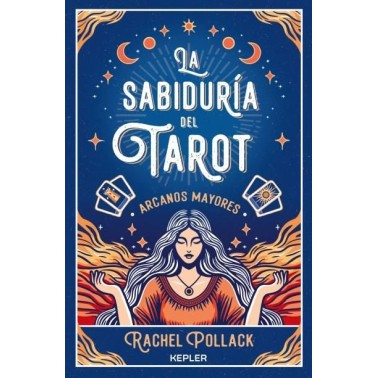
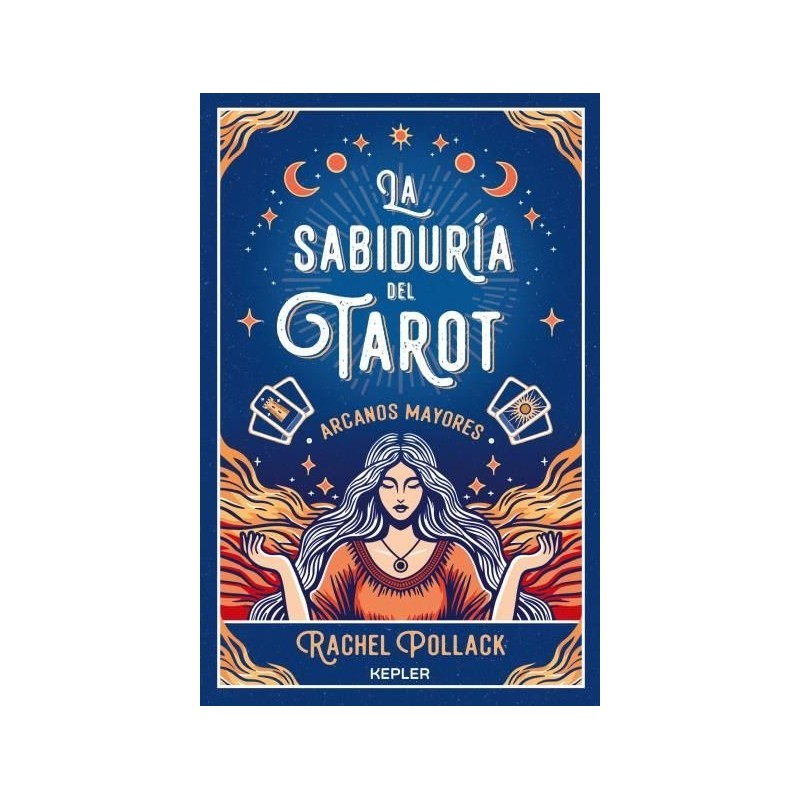
Discover The Wisdom of the Tarot by Rachel Pollack: Major Arcana, a 336-page book published by Kepler , which invites you to delve deeper into the meaning of the cards, the history of the tarot, and its many possibilities for interpretation.
Written by Rachel Pollack , one of the most influential authors in the contemporary study of tarot, this book offers an approach that combines history, art, psychology, symbolism, and different spiritual and occult traditions.
Conceived as a continuation of her celebrated work The Seventy-Eight Degrees of Wisdom of the Tarot , it incorporates new reflections, experiences, and reading methods developed by the author over decades of research and practice.
The book proposes to study the cards from different perspectives, compare their representations in seven decks and discover original spreads for predictive, psychological, magical and spiritual readings.
✨ A reading especially recommended for tarot students, tarot readers, fans of the Major Arcana and people who wish to delve deeper into the symbolic language of the 78 cards.
The wisdom of the Tarot stands out for offering a broad and reflective interpretation of cartomancy, beyond the brief meanings that appear in numerous introductory manuals.
Its main features include:
📖 336 pages of study: an extensive work dedicated to the symbolism and interpretation of the tarot.
🔮 Analysis of the 78 cards: the editorial synopsis presents an exploration of the entire tarot deck.
🌙 Special interest in the Major Arcana: as indicated by the subtitle of the Spanish edition.
🎨 Comparison of seven decks of cards: different visual representations to study their similarities and differences.
🧠 Psychological perspective: interpretation of the cards as images related to human experiences and processes.
🏛️ History of the tarot: reflections on its background and evolution.
✨ Spiritual and occult traditions: an approach to different symbolic systems.
🃏 Original print runs: proposals to expand reading possibilities.
📚 Continuation of a classic: a new approach to the work begun in The Seventy-Eight Degrees of Wisdom of the Tarot.
🇪🇸 Spanish edition: translated by Natalia Barry and published by Kepler.
It is a particularly interesting work for readers who seek to understand the letters in depth and develop a personal interpretation based on study.
Rachel Pollack (1945-2023) was a writer, teacher, and tarot scholar, internationally recognized for her contributions to the symbolic and psychological interpretation of the cards.
His work , The Seventy-Eight Degrees of Tarot Wisdom, became a reference for several generations of tarot students and readers.
Pollack advocated an approach that combines knowledge of symbols with imagination, personal experience, and reflection.
In addition to writing about tarot, he developed an important career in fantasy literature, science fiction, and comics.
He also created his own deck, The Shining Tribe Tarot , and participated in projects related to other decks and interpretation systems.
His career helps explain why his books continue to be used as study material within contemporary cartomancy.
One of the main attractions of this volume is its relationship to Rachel Pollack's best-known work.
The seventy-eight degrees of wisdom of the tarot helped popularize a way of studying the cards that pays special attention to symbols, archetypes, and human experiences.
In The Wisdom of the Tarot , Pollack revisits that universe of knowledge and expands it with new ideas and reflections.
The author incorporates perspectives acquired during the decades following the publication of her classic work.
The result is a book that can be read as a complement to that title, but which also offers interest to those who wish to discover directly his way of understanding the tarot.
It does not simply repeat traditional meanings: it proposes new ways of observing the images, relating the cards, and developing readings.
The 22 Major Arcana constitute one of the most recognizable parts of the tarot.
His images represent characters, situations, and concepts that can be symbolically interpreted as different experiences of human life.
From The Fool to The World, the Major Arcana are often studied as a journey through learning, decisions, transformations, and personal development.
Within contemporary interpretation, each card can be explored from different perspectives: historical, psychological, spiritual, artistic, and narrative.
Rachel Pollack's work is especially relevant to this type of reading, because it invites us to observe the meaning of symbols and their relationships, rather than simply memorizing keywords.
0. The Fool: beginnings, freedom, exploration and openness to new experiences.
I. The Magician: initiative, creativity, skills and capacity for action.
II. The High Priestess: intuition, mystery, inner knowledge and contemplation.
III. The Empress: creativity, symbolic fertility, abundance and expression.
IV. The Emperor: structure, authority, stability and responsibility.
V. The Hierophant or High Priest: tradition, teaching, beliefs and transmission of knowledge.
VI. The Lovers: bonds, choices, values and relationships.
VII. The Chariot: will, movement, direction and determination.
VIII. Strength: courage, self-control, patience, and inner fortitude.
IX. The Hermit: introspection, search for wisdom and reflection.
X. The Wheel of Fortune: cycles, changes and variable circumstances.
XI. Justice: balance, responsibility, decisions and consequences.
XII. The Hanged Man: pause, change of perspective and acceptance.
XIII. Death: endings, transformation and renewal.
XIV. Temperance: moderation, integration, harmony, and adaptation.
XV. The Devil: attachments, conditioning, desires and limitations.
XVI. The Tower: rupture of structures, revelation and unexpected change.
XVII. The Star: hope, inspiration, confidence and renewal.
XVIII. The Moon: uncertainty, imagination, emotions and mystery.
XIX. The Sun: clarity, vitality, joy and expression.
XX. The Judgment: awakening, evaluation, recognition and transformation.
XXI. The World: culmination, integration, realization and closing of cycles.
These associations are a general guide to the Major Arcana in the tarot tradition; they do not constitute a transcription of Rachel Pollack's specific interpretations.
Although the subtitle of this Spanish edition highlights the Major Arcana, the editorial presentation also describes the study of the 78 tarot cards.
In a traditional tarot, the 56 Minor Arcana are usually distributed into four suits: Wands, Cups, Swords, and Coins.
Each stick is usually symbolically related to different dimensions of experience.
They are frequently associated with initiative, creativity, motivation, and projects.
They are related to emotions, bonds, sensitivity, and affective experiences.
They are interpreted in relation to thought, communication, conflicts, and decisions.
They usually represent resources, work, stability, material aspects, and practical results.
Reading the Minor Arcana allows you to complement the great symbolic themes of the Major Arcana with more concrete situations.
One of the most interesting features of the book is the use of images from seven different decks of cards .
The tarot has evolved through numerous artistic traditions and systems of interpretation.
The same card can feature different characters, colors, objects, or compositions depending on the deck.
Comparing these representations allows us to discover how the symbolic emphasis of an image changes and how artistic decisions influence its interpretation.
For example, the meaning of a letter can be enriched by observing its visual elements in different versions.
This methodology is especially useful for students who want to understand tarot as a language of images, rather than just memorizing definitions.
Rachel Pollack is especially known for her contributions to the psychological interpretation of the tarot.
From this perspective, the cards can be used as images that stimulate associations, memories, questions, and personal reflections.
The characters and scenes in the tarot can be symbolically related to human experiences such as fear, hope, conflict, change, and the search for meaning.
This approach does not require considering the cards as a literal prediction system.
It also allows them to be used as a narrative and introspective resource.
Studying symbols can help formulate questions and consider a situation from different points of view.
Tarot is not a tool for psychological diagnosis nor does it replace professional care.
The first documented tarot decks appeared in Europe during the 15th century.
They were initially used as playing cards, especially in certain regions of Italy.
Over time, different authors and esoteric movements developed symbolic and divinatory interpretations.
During the 18th and 19th centuries, associations between tarot and various occult traditions became popular.
In the 20th century, decks such as Rider-Waite-Smith and other modern systems profoundly influenced the practice of cartomancy.
Rachel Pollack's work is part of this contemporary evolution and proposes to study letters by considering both their history and their symbolic meanings.
The editorial presentation of The Wisdom of the Tarot highlights different ways of reading.
Within divination traditions, some people use cards to interpret future possibilities or scenarios.
These readings belong to the realm of esoteric beliefs and do not constitute scientifically proven methods for predicting events.
Use the images as stimuli to reflect on thoughts, emotions, and personal experiences.
It relates to the symbolic use of cards within ritual practices and esoteric traditions.
It seeks to explore issues related to personal meaning, values, and the inner search.
The book presents new ideas and approaches that allow one to understand these different forms of interpretation.
A practical way to use The Wisdom of the Tarot is to combine its reading with your own deck of cards.
Study proposal:
Select a card from your tarot deck.
Look closely at the illustration.
Write down the visual elements that most attract your attention.
Check out Rachel Pollack's explanations.
Compare their ideas with your first impressions.
Observe how the card changes in other decks, if you have them.
Perform a simple reading.
Record your conclusions in a notebook.
This method can be useful for developing a deeper relationship with tarot symbols.
A general suggestion to accompany the study is to use three cards.
First letter – The situation
It symbolically represents the context of a question.
Second letter – What should be understood
It invites us to observe factors, emotions, or perspectives that may go unnoticed.
Third letter – Possibilities
It proposes reflecting on decisions and alternatives.
This print run is a practice suggestion and not a reproduction of the original print runs included in the book.
The wisdom of the Tarot can be useful at different stages of learning.
For beginners:
It offers a broad approach to symbolism, history, and different ways of understanding cards.
For intermediate students:
It allows for a deeper exploration of the associations between images, meanings, and reading methods.
For experienced tarot readers:
It provides complementary perspectives and proposals for revising known interpretations.
For collectors:
The comparison between seven decks offers interest to those who enjoy studying different styles and systems of tarot.
This book may be of particular interest to:
People who want to learn tarot.
Students of the Major Arcana.
Professional and amateur tarot readers.
Readers of Rachel Pollack.
People interested in esoteric symbolism.
Fans of the history of tarot.
Card collectors.
People interested in psychological tarot.
Readers of spirituality and self-knowledge.
Those looking for a reference book to interpret cards.
People who want to expand their throwing methods.
Lovers of cartomancy and the occult.
Title: The Wisdom of the Tarot by Rachel Pollack: Major Arcana.
Original title: Rachel Pollack's Tarot Wisdom.
Author: Rachel Pollack.
Translator: Natalia Barry.
Publisher: Kepler.
Publishing group: Ediciones Urano.
Collection: Kepler Esotericism.
Language: Spanish.
Publication date: October 14, 2025.
Number of pages: 336.
Binding: Paperback.
Dimensions: 15 × 23 cm.
Approximate weight: 494 g.
ISBN: 9788419656056.
Format: Printed book, no deck included.
It is a book dedicated to the study and interpretation of the tarot from historical, artistic, psychological, spiritual and occult perspectives.
She was a writer and scholar of the tarot, recognized for her influence on the contemporary interpretation of the cards and for works such as The Seventy-Eight Degrees of Wisdom of the Tarot.
It contains 336 pages .
The Spanish subtitle is Major Arcana, but the editorial synopsis also presents a study of the 78 tarot cards.
No. It's a tarot study book; it doesn't include a deck.
Kepler, an imprint of Ediciones Urano.
Yes. This edition is translated into Spanish by Natalia Barry.
The wisdom of the Tarot is presented as a continuation that incorporates new reflections, experiences, comparisons between decks and reading proposals.
Yes. The editorial synopsis announces original print runs for different interpretive approaches.
It may be of interest to beginners interested in studying the tarot in depth, although its content is also aimed at experienced readers.
The editorial presentation confirms the use of seven different decks, but does not identify all of their names.
You can find Rachel Pollack's The Wisdom of the Tarot: Major Arcana, ISBN 9788419656056 , at Hostenatura , an online store specializing in books on tarot, cartomancy, oracles and esotericism.
If you're looking for a book to delve deeper into the symbolism of the tarot and discover new ways to interpret its cards, this work by Rachel Pollack is a particularly interesting option.
Its 336 pages bring together history, art, psychology, esoteric traditions and reading methods, offering a broad perspective for students and tarot readers.
At Hostenatura you will also find Rider-Waite-Smith decks, Tarot of Marseille, cartomancy books, mats and accessories for readings.
🔮📚 Discover The Wisdom of the Tarot by Rachel Pollack and expand your knowledge of the Major Arcana, the 78 cards and the symbolic language of the tarot.
Discover The Wisdom of the Tarot by Rachel Pollack: Major Arcana, a 336-page book published by Kepler , which invites you to delve deeper into the meaning of the cards, the history of the tarot, and its many possibilities for interpretation.
Written by Rachel Pollack , one of the most influential authors in the contemporary study of tarot, this book offers an approach that combines history, art, psychology, symbolism, and different spiritual and occult traditions.
Conceived as a continuation of her celebrated work The Seventy-Eight Degrees of Wisdom of the Tarot , it incorporates new reflections, experiences, and reading methods developed by the author over decades of research and practice.
Contact us!
Contact us on WhatsApp!